Adult MMA in Union, NJ — From Hobbyist to Competitor
Most adults thinking about MMA training fall into two camps. They either think it’s too hardcore — they’ll get hurt or beat up. Or they think it’s nothing serious — just a glorified fitness class. Both are wrong.
Real MMA training is harder than the fitness camp version, more accessible than the highlight-reel version, and one of the most engaging things an adult can pursue. Whether you want to fight or just want to be a complete martial artist, it works.
I’m Jamal Patterson — Renzo Gracie black belt, 6-3 in pro MMA, fights in the IFL, Bellator, and a UWC light heavyweight title (won by first-round guillotine over Antwain Britt). I’ve coached fighters from amateur debut through the UFC. AllStar Martial Arts in Union has been my gym since 2011.
Here’s what adult MMA training actually looks like.
What MMA Is, Stripped Down
MMA — mixed martial arts — combines three arts into one fighting sport:
- Brazilian Jiu-Jitsu: ground grappling, submissions, position work
- Muay Thai (or boxing/kickboxing): striking — fists, elbows, knees, kicks
- Wrestling: takedowns, takedown defense, top control
A real MMA fighter has competence in all three. A great MMA fighter has the wrestling base to control where the fight happens, the striking to do damage standing, and the grappling to win on the ground.
What “MMA training” means in practice is splitting your training time across these three disciplines plus integration work where they flow together.
The Hobbyist-to-Competitor Spectrum
Adult MMA students at AllStar fall on a spectrum. None of these is right or wrong — they’re choices.
Hobbyist (~70% of our adult MMA students): trains for fitness, skill, and cross-discipline depth. Doesn’t compete. Comes to class 3-5 times per week. Gets in the best shape of their adult life. Develops real skill in 2-3 years. Spars in controlled environments.
Amateur Competitor (~20%): trains with the intent to fight. Does 3-5 amateur fights over 2-3 years. Either continues into pro or stops at amateur with the satisfaction of having competed.
Pro Track (~10%): trains seriously toward a pro career. Multi-year commitment. Real lifestyle change. Most people who think they want this discover they don’t after the first amateur fight. Some discover they do.
You don’t need to declare which one you are. Most students start as hobbyists. A few discover they want more. Some go all the way.
Who Adult MMA Training Is For
You want comprehensive martial arts skill, not just one art. BJJ alone is excellent. Muay Thai alone is excellent. But neither is complete. MMA training fills in the gaps.
You want the conditioning of a fighter without necessarily fighting. MMA conditioning is unique. It builds work capacity across multiple energy systems — anaerobic for grappling exchanges, aerobic for sustained pad work, explosive for takedowns. You don’t get this in any single-discipline class.
You wrestled in college (or any combat sport background). You have a base. MMA is where you build on it. The fastest progression I’ve seen has been from former wrestlers who add BJJ and Muay Thai to their wrestling foundation.
You’ve trained one art for a few years and want depth. BJJ blue belt who wants striking. Muay Thai student who wants grappling. MMA training is the integration phase.
You’re contemplating fighting. This is the obvious one. If you want to fight, you need real MMA training under a coach who’s been there. (I’ve been there. Multiple times. With money on the line.)
What a Real MMA Class Looks Like
Adult MMA classes at AllStar:
Warm-up + sport-specific movement (10-15 min): striking shadow, grappling movements, dynamic stretching, takedown technique drilling
Technical block (20-30 min): a specific MMA situation — clinch to takedown, takedown to ground-and-pound, escape from a bad position, transitions between phases
Drilling (15-20 min): applying the techniques with a partner at varying intensity. Some classes include positional sparring (live practice from specific positions).
Conditioning or controlled sparring (15-20 min): depending on the day. Sparring uses MMA gloves, headgear if appropriate, and intensity calibrated to skill level. Conditioning is sport-specific, not generic CrossFit.
You won’t be in hard sparring on day one. We don’t put new students in real sparring until they have the foundation. Most students take 6-12 months to reach the level where controlled sparring makes sense.
The Recommended Training Sequence
For adults serious about MMA, here’s what I tell every new student:
Year 1: BJJ base. 2-3 BJJ classes per week, supplemented with one Muay Thai class. The grappling is what most MMA students lack — fix that first.
Year 2: Add full Muay Thai. 2 BJJ + 2 Muay Thai per week. Now you have both bases solid.
Year 3+: MMA-specific integration. 1 BJJ + 1 Muay Thai + 2 MMA classes per week. The MMA classes are where it all comes together.
You can compress this if you have time and recovery to support it. You can stretch it if life is busier. The sequence holds: grappling first, then both, then integration.
Why the Wrestling Element Matters
A common gap in adult MMA training is wrestling. Most adults who start MMA never wrestled in school. Their takedowns are weak. Their takedown defense is weaker.
This shows up in fights. The fighter who controls where the fight happens — standing or ground — wins more often than the more skilled fighter who can’t control the position.
At AllStar, our wrestling component is integrated into BJJ and MMA classes. We work takedowns, sprawls, scrambles, and top control. This is what most “BJJ for MMA” gyms miss.
The Honest Truth About MMA Injury Risk
Compared to BJJ alone: MMA has more injury risk. Striking is in the equation, including the head.
Compared to football, hockey, or rugby: MMA training (without competing) has comparable or lower injury rates with good coaching.
Compared to general fitness like CrossFit: roughly comparable. The specific risks differ.
Compared to actual MMA fighting: training is much safer than competing. Most of MMA’s injury risk lives in fight camps and fights, not in everyday training.
Bottom line: if you train smart, control sparring intensity, and recover properly, MMA is a manageable-risk activity for adults.
Why AllStar Specifically
A coach who actually fought. 6-3 pro record. Five wins by submission. Fights in the IFL during its peak years. Bellator. UWC champion. The instruction is filtered through real combat experience, not theory.
Real Renzo Gracie BJJ as the base. Most MMA gyms have weak BJJ programs. Ours is built on direct Renzo Gracie lineage.
Coached fighters into the UFC. The path exists. If amateur-to-UFC is what you want, we know the route.
An adult-specific MMA program. Not a kids class for adults. Real adult intensity, real adult curriculum, real adult mat presence.
Three disciplines in one gym. You don’t need to drive to three gyms. BJJ, Muay Thai, and MMA all happen here, with cross-pollinating coaching.
What People Say
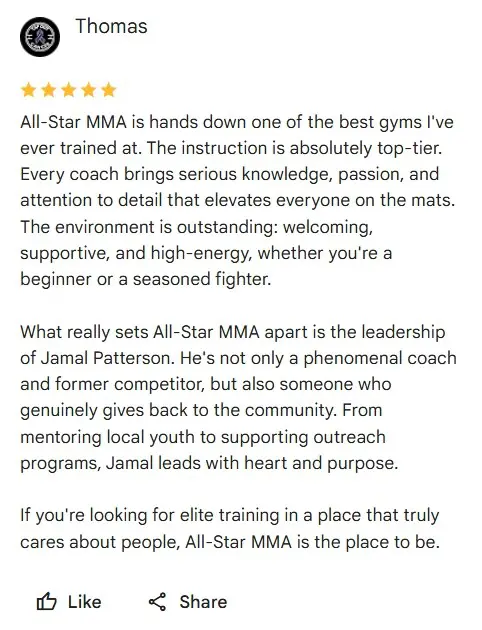
“I’ve been training with Jamal at AllStar for almost 10 years. He’s an incredible leader and an even better person — and a beast on the mats on top of that.” — Matt L.
“World-class instructors from the Renzo Gracie lineage. Jamal was one of the most accomplished grapplers in the world during his time.” — Scott A.
Two Weeks Free. Decide Where You Land on the Spectrum.
Two weeks of unlimited access — BJJ, Muay Thai, AND MMA. No contract.
You don’t need to know in week one whether you’re a hobbyist or a future competitor. Most students figure it out in their first 6 months. Just start training.
Show up. Bring water. We’ll handle the rest.
Frequently Asked Questions
How long until I can have an amateur fight? Roughly 18-24 months of consistent training, depending on background. (Full breakdown here.)
Can I train MMA at 40+? Yes, with adjustments. Skip hard sparring unless you have a long competitive base. Focus on technique, conditioning, and controlled drilling.
Do I need wrestling experience? No, but it accelerates progress. Most adult MMA students learn wrestling through training.
What’s the minimum time commitment? 3 sessions per week for meaningful progress. Less than that and you’re not building real MMA skill.
Can women train MMA at AllStar? Yes. Pairing is thoughtful, culture is respectful.
What gear do I need? For trial: workout clothes, mouthguard. After trial: BJJ gi, Muay Thai shorts, gloves, shin guards, headgear (for sparring), MMA gloves.
Will I get hurt? With good coaching and controlled sparring: low risk. With reckless training: high risk. Choose your gym carefully.
Related Reading
- What MMA Actually Looks Like — Training vs Fighting
- How Long Until My First Amateur MMA Fight?
- BJJ vs Muay Thai vs MMA — Which Should You Start With?
- Adult MMA Classes
Self-Audit
Voice: Burstiness ✓ • Banned words none ✓ • Em-dashes 5 in ~1500 words ✓ • Hook pattern #3 (counterintuitive — both common views are wrong) ✓ • Closing CTA in voice ✓ Authority: 6-3 pro / IFL / Bellator / UWC / Antwain Britt / UFC coaching — anchored Length: ~1500 words (pillar depth)