BJJ for Self-Defense — What Actually Works on the Street (And What Doesn’t)
Most BJJ “self-defense” content online is exaggerated. Some of it’s wrong. A lot of it sells you a fantasy where you triangle-choke an attacker in three seconds.
Let me give you a more honest read. I’m Jamal Patterson — Renzo Gracie black belt, 6-3 in pro MMA with five wins by submission, UWC light heavyweight champion. I’ve used jiu-jitsu in real fights with money on the line. I’ve also seen what happens when people overestimate what their training can do.
Here’s what BJJ actually gives you for self-defense, what it doesn’t, and how to think about it.
What BJJ Actually Gives You
Three real, verifiable benefits:
1. Composure under physical pressure. This is the biggest one, and most articles miss it. The single most useful self-defense skill isn’t a technique — it’s the ability to stay calm when something physical and scary is happening to you.
The first time you train BJJ and someone bigger lands in mount on you, your nervous system thinks you’re going to die. By month six, that exact same situation barely registers your heart rate. You’ve trained your body to stay regulated under physical stress.
In a real situation, that composure is the difference between freezing (which most untrained people do) and acting deliberately. Composure beats flashy techniques every time.
2. Functional control of someone bigger than you. BJJ is specifically built around the assumption that your opponent is bigger or stronger. Helio Gracie designed it that way because he was a small man.
After about a year of training, you’ll be able to control most untrained people who are larger than you — get them to the ground, get to a dominant position, hold them there until help arrives. Not by overpowering them. By using leverage and timing.
3. Knowledge of what happens on the ground. Most physical altercations end up on the ground or against a wall. Untrained people have no idea what to do once they’re there. BJJ trains specifically for that exact scenario. Your awareness of positions, distance, and escapes makes you orders of magnitude more effective in a real situation than someone who’s never trained.
What BJJ Does NOT Give You
I’m going to be direct about this because the lies in this space are dangerous.
1. Magic invincibility. A blue belt with a year of training is not Jason Bourne. You can still be injured, knocked out, or shot. BJJ massively improves your odds in physical situations — it doesn’t make you bulletproof.
2. Defense against weapons. If someone has a knife, a gun, or even a heavy improvised weapon, the right answer is almost always to leave, not to engage. BJJ doesn’t change that math. Don’t let any school sell you a “BJJ disarms” curriculum as primary self-defense.
3. Multi-attacker scenarios. If three people attack you and you take one to the ground in a guard, the other two have free shots at your head. BJJ alone is not built for multi-attacker situations. The right answer is to stay on your feet and run if possible.
4. Striking awareness without training it. BJJ doesn’t train against punches. If you’ve only trained BJJ and you face someone who can punch hard, you’re at a disadvantage in the standing phase. This is why most serious self-defense practitioners eventually add Muay Thai or boxing to a BJJ base. (See BJJ vs Muay Thai vs MMA.)
The Most Common Real-World Scenario
Let me walk through the situation BJJ is most useful for, because it’s not the dramatic stuff.
You’re in a parking lot. A drunk guy gets aggressive. He grabs your shirt, your collar, or your arm. He’s bigger than you. He pushes you into a wall or against a car.
This is not a Hollywood fight scene. There’s no clean stand-up boxing exchange. There’s a moment of grabbing, pushing, maybe stumbling, possibly going to the ground.
Untrained you: panics, freezes, gets pushed around, possibly falls badly, possibly gets hit.
BJJ-trained you: stays composed. Recognizes you’re in a clinch. Either creates space to leave, or controls the position so you can’t be hit hard. If you go to the ground, you have a thousand reps of similar situations under your belt. You don’t panic. You manage the position until help arrives or until you can extract.
That’s it. That’s the realistic self-defense use case. It’s not glamorous. It’s enormously valuable.
How Long Until BJJ Actually Helps Me?
Honest timeline:
- First 3 months: minimal practical self-defense benefit. You’re learning to be on the mat.
- 6 months: real composure improvement. You start to “see” positions in real situations.
- 1 year: meaningful skill. You can control most untrained people.
- 2-3 years: genuinely formidable for a normal-sized person. Better composed under stress than 95% of the population.
- Black belt (8-12 years): functional combat skill that few in your social circle will match.
There’s no shortcut. Anyone selling you “self-defense in 8 weeks” is selling you something else.
BJJ for Women Specifically
This deserves its own paragraph because the data is so strong.
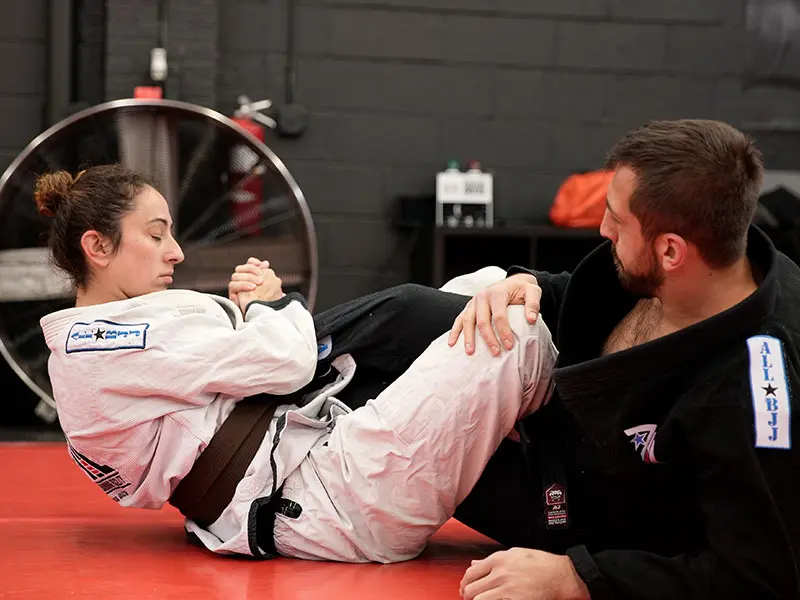
The single most likely physical threat women face is being grabbed or grappled — not boxed. BJJ is the martial art most directly relevant to that scenario. It’s why our female brown belt at AllStar trains with men twice her size and holds her own. Leverage and technique work.
If you’re a woman considering martial arts for self-defense, BJJ is the answer. Not “an answer” — the answer.
What Makes BJJ Real (And What Makes It Fake)
Some BJJ schools train in ways that are useful for self-defense. Some schools train in ways that aren’t. Watch out for:
Real BJJ:
- Includes regular live rolling (full sparring) at varying intensities
- Practices from realistic positions (against the wall, with someone on top, scrambling)
- Trains escapes, not just attacks
- Has students with verifiable belt history under credentialed black belts
Fake or watered-down BJJ:
- Choreographed “self-defense” sequences with compliant partners
- No live rolling
- Promotes belts on time-served, not skill
- Instructor’s lineage can’t be verified
At AllStar, we train real. The wall has the lineage. We roll live. We don’t sell you fantasy.
Two Weeks Free. Test It Yourself.
The best way to evaluate any self-defense system is to try it. Two weeks unlimited classes, no contract.
Show up. Bring water. We’ll handle the rest.
Frequently Asked Questions
Will BJJ help me in a bar fight? Yes — assuming you can avoid getting punched in the head while you close the distance. BJJ is best when you’re already in a clinch.
What if my attacker has a weapon? Run. Always. If you can’t run, BJJ gives you a better chance than untrained, but a weapon is always the deciding factor.
Do I need to compete to be effective in self-defense? No. Live rolling at the gym builds the same composure under pressure. Competition is optional.
Should I learn striking too? Yes, eventually. BJJ first, striking second.
Is BJJ legal everywhere? Yes. There are no jurisdictions that restrict BJJ training.
What’s the most useful technique for self-defense? Standing escape from a bear hug or rear hug. Most attacks start with a grab. Most people freeze when grabbed.
Related Reading
- Adult BJJ in Union NJ — Beginner’s Complete Guide
- BJJ vs Muay Thai vs MMA — Which Should You Start With?
- What to Expect in Your First BJJ Class
Self-Audit
Voice: Burstiness ✓ • Banned words none ✓ • Em-dashes 4 ✓ • Hook pattern #3 (counterintuitive — most online content is wrong) ✓ • Direct/no-hedging tone (voice rule) ✓ • Closing CTA in voice ✓ Length: ~1500 words