What to Expect in Your First BJJ Class — A Real Walkthrough
Almost every new adult student feels the same thing on the drive over: a quiet kind of dread.
You’re picturing yourself getting smashed by someone half your age. You’re worried you’ll embarrass yourself. You’re second-guessing why you signed up. You’re wondering if you should turn around.
I’ve watched a thousand first classes. The dread is universal. It’s also wrong about what’s actually going to happen. Here’s the real walkthrough — minute by minute, so you know exactly what you’re walking into.
Before You Get to the Gym
You don’t need anything special. Workout clothes (shorts, t-shirt — nothing loose with zippers or pockets), water, an open mind. We’ll lend you a gi during your trial.
Eat at least 2 hours before class. Light meal. You don’t want to be full but you don’t want to be running on empty either. Hydrate before you arrive.
Get there 10-15 minutes early. We’ll walk you through the gym, introduce you to the coach, and give you a quick orientation.
Walking In
You sign in at the front desk. Someone shows you the changing area. You change into your gi (we’ll show you how to tie the belt — this is way more confusing than it should be the first time). You walk onto the mat.
Mat etiquette: shoes off before stepping on the mat. Always. Bow or nod when stepping on or off (basic respect, not religious).
If we have a kids class wrapping up, give it a minute. The kids matter to us as much as the adults do, so we don’t rush them off.
The Warm-Up
Class starts with light movement — usually 5-10 minutes. Things like:
- Shrimping (a hip movement that’s foundational to BJJ)
- Forward and backward rolls
- Bear crawls
- Light stretching
You’ll feel uncoordinated. Everyone does. The shrimping motion in particular looks weird until you do it for a month, at which point it’s so natural you forget you ever struggled with it.
Don’t worry about being slow or off-rhythm. The warm-up isn’t a test. It’s prep work.
Technique Time
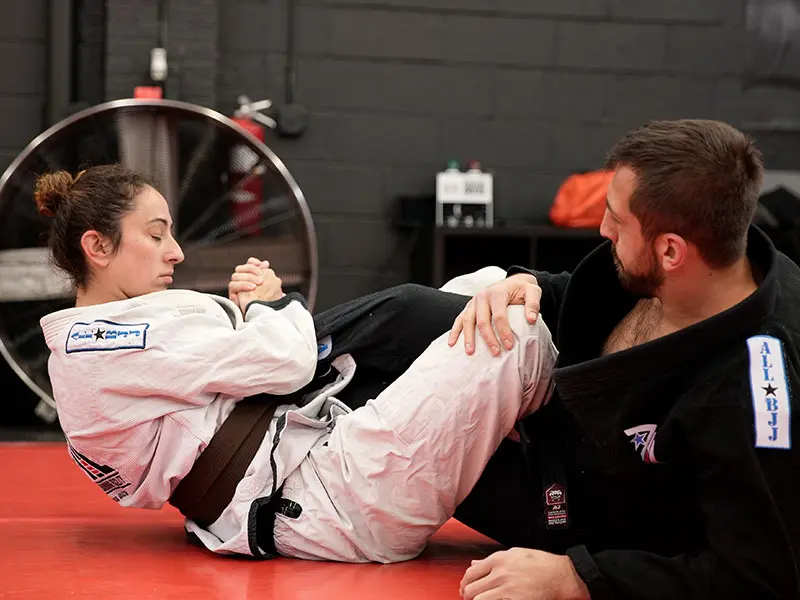
This is the heart of class. The coach demonstrates a technique. Then you and a partner drill it.
For your first class, we’ll usually pair you with an experienced student or assistant instructor — somebody who can guide you through the movements without trying to get a workout from you. They’re going to be patient. That’s the culture.
You’ll learn 1-2 techniques. Don’t try to memorize everything. Try to do the technique cleanly five times. That’s enough for one day.
If the coach corrects something, listen. If your partner gives you a tip, listen. Both of these are gifts. Take them.
Positional or Live Practice
Toward the end of class, you might do positional drilling (starting from a specific position and trying to achieve a specific goal) or light rolling (full sparring at controlled intensity).
For your first class, you probably won’t roll hard. We’ll either skip it for you or pair you with someone who’ll go easy.
You’ll get tapped. You won’t get hurt. Tapping is how you tell your partner “stop, you’ve got me.” It’s normal. It’s how everyone learns.
The first time you tap, you might feel embarrassed. Don’t. Tapping is the most basic skill in BJJ — recognizing when you’re caught and acknowledging it. People who don’t tap get hurt. People who tap freely learn faster.
End of Class
Class ends with a line-up — students bow to each other and to the coach. You’ll shake hands with everyone you trained with. Brief social moment. People will introduce themselves.
You’ll be soaked in sweat. Your forearms will be tired in a way you’ve never felt before. Your hips will be sore from movements you didn’t know existed.
You’ll also feel something else — a clarity. Most people describe it as “the only hour of the day when nothing else mattered.” That’s the addiction starting.
What People Get Wrong on Day One
Trying to be good. You won’t be. Don’t try. Try to learn.
Going too hard. Save your gas. You’ll get more out of light, deliberate practice than from grinding.
Skipping water. Hydrate during class. BJJ is more cardio than people expect.
Comparing themselves to other students. The white belt next to you might have been training six months. The white belt across the mat might have started yesterday. Comparison is a waste of mental energy.
Worrying about looking awkward. Everyone looked awkward on day one. Including me. Including Renzo Gracie when he started. The mat doesn’t care.
What People Get Right on Day One
Asking questions. Coaches and senior students love questions. Ask anything.
Tapping early. No ego. Tap when caught. Train another day.
Coming back the next class. Most people who quit BJJ quit after class one or class two. The dropoff curve is brutal. If you can get past the first three classes, you usually stay for years.
After Your First Class
Some honest observations:
- Your forearms will be sore for 2-3 days. This goes away within a few weeks as your grip strength catches up.
- You’ll be hungry. BJJ is a serious workout.
- You’ll think about it. The techniques will replay in your head. That’s the brain working things out.
- You’ll want to come back. Don’t fight that feeling.
How AllStar Handles First-Timers
I’ve been coaching adults at AllStar in Union since 2011. We have a specific process for first-day students:
- A senior staff member walks you through everything I described above
- You’re paired with someone who’ll guide you, not test you
- You’re not expected to keep up with the experienced students
- The coach checks on you mid-class to answer questions
- We follow up after class to see how it went
This isn’t unique to us, but it’s not universal either. Some schools throw new people in the deep end. We don’t.
Two Weeks Free. First Class on the House.
If you’ve read this far, you’re closer than you think to walking in. The dread you feel is normal and almost always wrong about what’s coming.
Two weeks of unlimited classes, no contract. Gear included for the trial.
Show up. Bring water. We’ll handle the rest.
Frequently Asked Questions
How long is a class? Typically 60 minutes. Fundamentals classes for beginners often 45 minutes.
Do I need to be in shape? No. You’ll get in shape from training. Most adults arrive out of shape and improve fast.
What if I freeze up or panic during rolling? Tap. Stand up. Take a breath. Re-engage when you’re ready. We’ve all done it.
Will my partner be respectful? Yes. BJJ culture is built around mutual respect. Anyone who isn’t respectful gets corrected by the room.
How much should I tap on day one? As often as you need to. There’s no shame in tapping. Tapping is wisdom.
What if I have an injury? Tell the coach before class. We’ll work around it.
Related Reading
- Adult BJJ in Union NJ — Beginner’s Complete Guide
- BJJ vs Muay Thai vs MMA — Which Should You Start With?
- Gi vs No-Gi BJJ for Beginners
Self-Audit
Voice: Burstiness ✓ • Banned words none ✓ • Em-dashes 4 ✓ • Hook pattern #1 (specific moment — “the drive over”) ✓ • Closing CTA in voice ✓ Length: ~1450 words